Wednesday, January 30, 2013

Philippe's

Photo collection LAPL

The Chew today paid a visit to one of my favorite restaurants in Los Angeles, Philippe's. The originator of the French Dip sandwich, the legend goes that when making a sandwich for a fireman named French, the top bun fell into the au jous, and the fireman took it anyway. The next day he came back with a whole bunch of buddies wanting to try this fantastic accident.


Just off Ceasar Chavez Blvd (which becomes Sunset) near Union Station, Olvera Street, and Chinatown it's an essential part of any stop in downtown Los Angeles. It's also a favorite before or after a Dodger game, with the stadium just up the road on Sunset.

When Anthony Bourdain visited Phillipe's with the LA roller derby girls, they told him the lamb is the best, though the roast beef is the standard. Either are fantastic, but it's the atmosphere that sells Phillipe's for me more than anything. There's still sawdust on the floor (a preventative mess that makes spills easier to clean up) and the cigarette counter has been converted to candy and merchandise sales. Coffee was still a dime up until a year ago, and it's still cash only.

Yay Philippe's!

Wednesday, November 7, 2012

California and Los Angeles Politics - A History

Photo collection LAPL

This blog has always been a personal project to me, so you'll have to indulge me for a moment as I do a somewhat pedantic trod through the history of political parties in the United States. Ultimately, I hope to arrive at Los Angeles' political history.

At the time of Los Angeles' incorporation on April 4, 1850, the modern political party system had already solidified. In 1797 Tennessee was admitted as a state, and Andrew Jackson was one of its original Representatives in the House. He then served a year as state Senator before resigning and becoming judge on the Tennessee Supreme Court. Jackson became a major general in the Tennessee militia in 1802.

Jackson became famous for fighting the "Red Stick" Indians in the War of 1812, with the help of Davy Crockett. After the war, Jackson went back into politics as a senator from 1823-1825. He was involved in the controversial Presidential Election of 1824 when the House had to chose the President because none of the candidates managed a majority of electoral votes.

Jackson's second Senatorial term was the 18th United States Congress. This was a time of chaos.

One of the two original political parties in the United States was the Anti-Administration party. They favored states rights and farmers, and opposed the Federalist policies of Alexander Hamilton. Thomas Jefferson became their champion and they formed the Democratic-Republicans or Jefferson-Republicans. They won three straight elections.

The Federalist party collapsed, leading to an influx of candidates to the Democratic-Republicans. When the House of Representatives chose John Quincy Adams of Massachusetts as President he was affiliated with the Democratic-Republicans, but the 18th Congress led to a bunch of factions.

Jackson's followers became the Democrats. They fought against elite and business interests, and stuck up for the white farmer. Poor Southern farmers became the party's base, and so the party was pro-slavery. For much of the history of the Democratic party, it was considered egalitarian and pro-Southern racism.

Adams' followers became the National Republicans also known as Adams Men, Anti-Jackson, and Anti-Masonic. Adams lost the bid for re-election to Andrew Jackson, then they ran Henry Clay against Jackson's bid for re-election and lost again.

This party eventually became the Whigs, who were supporters of business and markets, economic modernization, and social reform. It was the party of the North, where all the banks were, and eventually collapsed under the issue of slavery. The abolitionist faction of the party became the Republicans.

The previously mentioned Henry Clay of Kentucky was able to negotiate compromises as a Senator that staved off Civil War for 40 years. These included the Missouri Compromise of 1820 which established the Missouri Compromise Line above which slaves could not be held, and the Compromise of 1850. John C. Calhoun, Clay's Democrat colleague from South Carolina, argued that white slaveowners were the real oppressed minority to ensure war took place.

All this history informs any discussion of early Los Angeles politics. California was admitted to the union by the 31st US Congress as part of the Compromise of 1850. This concerned the admission of new land won in the Mexican-American War (during with Davy Crockett died defending the Alamo).

Slave states in the South wanted to admit California as two states, with Southern California admitted as a slave territory. The Compromise of 1850 lopped off part of Texas' tip (creating Oklahoma's panhandle) so that Texas could be admitted as a slave state. Texas also gave up some Western lands to pay off debts. It also allowed California to enter the union intact as a free state. New Mexico and Deseret (nee Utah) were denied entry and remained territories.

So it should be somewhat surprising that California's first two Senators were Democrats, after all that was the pro-slavery party. Senators before the 17th amendment were appointed by state legislatures. California elected two Representatives on a general ticket, a Democrat and an Independent.

Well the two men only served two months, before the 32nd Congress was formed. Also, they couldn't have been more different. William M. Gavin who served four terms (non-consecutive) was known in Washington D.C. as a determined Southern sympathizer. John C. Fremont later became the first Republican Presidential candidate with the slogan "Free Soil, Free Men, and Fremont" The Free Soil party had opposed the expansion of slavery into the new territories.

You might recognize Fremont's name, he's got a bunch of streets named after him as well as a city in Northern California.

Gavin was re-elected, but Fremont was followed by John B. Weller - a Lecompoton Democrat (pro-slavery). California continued to elected Representatives on a statewide At-Large basis until 1865.

By that point, the country was four years into the Civil War. California was a Union state without slavery. The Republicans had elected their first President, Abraham Lincoln, and it became the popular party in Congress.

Formed around abolitionist Whigs, it was the party of the North. This also made it associated with business and financial interests, industrialization, and social reforms such as Prohibition and Women's Suffrage.

John Conness, a Republican, was a Senator for California from 1863 to 1869. He introduced a bill to establish Yosemite National Park, voted to abolish slavery, but also advocated for Chinese immigration and civil rights. California's other senator was a National Unionist/War Democrat; they wanted a more aggressive policy toward the Confederacy. Unsurprising then that California had three Republican Representatives in the 39th congress.


The earliest Congressional District map I can find for California is from 1899. Notice how Los Angeles  is in a district that stretches up the coast to Santa Cruz, while Orange County is in a district with the central valley.

In 1899 California had two Republican Senators, and all seven districts had Republican Representatives. The second district along the Nevada border originally elected a Democrat, but he resigned and was replaced with a Republican.

Republicans dominated national politics after the Civil War, with only Grover Cleveland winning as a Democrat. Politics of that time had moved on from slavery into a debate on the medal standard for currency. Farmers and the poor represented by Democrats like William Jennings Bryan wanted a dual gold-silver standard to make debts easier to pay off. Bankers represented by Republicans wanted the opposite.

You can see how the basic economic principles of the parties have remained the same, which the social policies have changed to meet the needs of their constituency. The rise of unions after the turn of the century made Democrats the party of labor as well as farmers. As labor became a multicultural enterprise Democrats had to become the party of tolerance in the North, which lost them the Democrats in the South who are now a Republican base. This of course leads to a fractured Republican party serving two masters.

After the 17th amendment Senators were elected by the people, and California elected a Democrat named James D. Phelan who lost a re-election bid over his "Keep California White" campaign posters. It's 11 representatives were a mixture of Democrats, Republicans, and Progressives.


This 1911 Congressional District map has Los Angeles with two Representatives (a Prohibitionist and a Progressive (who was replaced by a Republican when he resigned)). Orange county is no longer connected with the Central Valley, but with the desert areas along the Nevada border.

The Great Depression cost the Republicans their good standing with the public, as they were largely blamed for causing it. The party had survived two post-Civil War panics, but after 1928 was the last year the Republicans would win the White House without a Bush or a Nixon on the ticket (Bush Sr. was Reagan's VP, Nixon was Eisenhower's).

It was a democrat from New York who changed everything. New York governor Franklin Delano Roosevelt united farmers, labor unions, academics, and minorities into the New Deal Coalition. Here's where the old Democratic Party starts to end and the new Democrats emerge.


Los Angeles has continued to grow exponentially and now has districts 11-18 (six Democrats and two Republicans). While the Democrats have begun to embrace minority workers, they still have the stink of racism on them. California's Democrat Senator at the time, William McAdoo, is endorsed by the Klu Klux Klan. That tinge of racism won't be shaken off until the 1960s when the Democrats support the Civil Rights movement.

Labor in Los Angeles and the Bay Area, as well as the two large public universities, has given California a solid Democrat base, but state has gone Republican in several elections since the New Deal. California actually went for Richard Nixon over John F Kennedy.

Los Angeles, however, went for Kennedy. The parties now are actually closer than they were at the turn of the century because of the crossover on social issues. Electoral maps pre-George W. Bush tend to be a landslide for one candidate or another and California went along with the winning party.

I lack a conclusion. Los Angeles politically is controlled by labor and minorities, and that continues to be the Democrats. It wasn't always that way, and it's fun seeing LA going from one of a few coastal counties in one district at the turn of the century to where it is today.

Thursday, August 16, 2012

Arden Ice Cream Takes a Trip Through Yester-LA

This is one of those entries where I'm not sure where it's going to go. I know it involves Ice Cream and a wagon. That's all I've got to go on. But I saw a neat picture, and I need to find the story.

The city of El Monte sits in between the Rio Hondo and San Gabriel rivers. It's a little oasis in the San Gabriel Valley. The name El Monte means the meadow or marsh or the wooded area. The perfect place perhaps to raise some cattle.

In 1904, Arden Farms was founded in El Monte, California. It was the first certified milk dairy in California. It was a state of the art facility for bottling milk.

Milk is California's largest agricultural commodity, in a state where agriculture is the number one industry. The history of milk legislation tends to be driven by fake milk products. In 1878 it was made illegal to sell oleomargarine (now just known as margarine) under the name of butter. In 1895 the California State Dairy Bureau was founded to prevent the sale of fraudulent butter and cheese.

In 1905 the Sanity Dairy Law was passed, prohibiting the sale of milk produced by unhealthy animals or under unsanitary conditions. Arden Farms was one year ahead of the curb.

Arden became a household name up and down the Pacific Coast in 1930 when they merged with California Dairies Inc. which was created by Western Dairy Products of Seattle to operate properties in California.  Western Dairy Products ran ice cream outlets in the pacific northwest.

When I first talked about agriculture on this blog, I mentioned that orange juice was heavily advertised to allow orange growers to have use for any surplus produced. The same argument can be made for luxury dairy products like ice cream. If you can increase the number of dairy products, you grow the dairy business into the huge industry that it is today.

Photo credit LAPL

I do love when a photograph can bring it all together. The building in the background is the Warner Downtown theater on 7th and Hill. The movie is Roman Holiday, the 1953 film that launched Audrey Hepburn's career. Paramount released The War of the Worlds just before Roman Holiday, perhaps that's why Roman Holiday was playing at the Warner. 

Remember (in case you didn't click the link) the Warner Downtown Theatre was originally a Pantages Theatre was designed by architect B. Marcus Priteca in a Greek Revival style in 1919, opening in 1920. 

Anyhow, the horse drawn wagon is being used to advertise Arden's newest ice cream flavor: Texas Pecan. I'm sure it was a prop from some western or another, and certainly there must have been a place to get some Arden ice cream nearby. 

Photo credit LAPL

Hey look! It's Cliftons! That's actor Lock Martin standing out in the crowd underneat the Clifton's sign, most famous for playing the robot in The Day the Earth Stood Still. They drove all around downtown, spreading the good word of this new ice cream flavor. Martin even came in and said howdy to the girls in the Arden ice cream plant. 

Photo credit LAPL

Of course, Arden wasn't without competition. Carnation was also a major west coast dairy operation. Balian ice cream company actually sued Arden in 1955 for lowering Arden ice cream prices purposefully in just Los Angeles trying to drive out the smaller creameries in the city.

We learn a little bit more about Arden in this court case. It was one of the largest dairy firms in the west in 1955. It owns one of the largest ice cream plants in the United States, which you see in the photo above. 


Tuesday, July 31, 2012

Los Angeles Olympic History - The Games Themselves

Last time out, I spent my time trying to describe the preparations necessary to host the events. How Agricultural Park was full of brothels and casinos, and the temperance movement lead by the Methodists at USC got the property transformed into Exposition Park and how Los Angles used the Olympics as a reason to transform that area. As has been my standard here, I focused on the structures erected, because they can be photographed and I like the pretty pretty pictures.

I didn't talk much about the games themselves. I talked about the Coliseum and the Swim Stadium and the Armory and the Olympic Auditorium and the Rowing Stadium, but I didn't talk about what happened inside of them. Well the LAPL has inspired me to look into what happened during the games themselves.

Heikki Savolainen of Finland on Vaulting Horse. Photo: LAPL

Here we have an Heikki Savolainen of Finland on the Vaulting Horse. The Finns took third in the team all around competition, and Savolainen took bronze in the individual all around competition. The individual all around took four days to complete.

The word gymnasium came to English in the late 16th century (Enlightenment) from the Greek word gumnazein meaning exercise naked. This from the word gumnos meaning naked. 

The ancient Greek gymnasium was a place to train for public games (although today it can be a place to train just for yourself). The athletes trained nude so that their athletic bodies could be admired, and as a tribute to the gods. 

With it came the word gymnaste meaning a trainer of athletes (though it now refers to the athlete). Every gymnasium had a palaestra, from the word palaiein meaning to wrestle where wrestling, boxing and the like would take place. 

I mentioned the Enlightenment? Well in 1569 Girolamo Mercuriale of Forli, Italy wrote Le Arte Gymnastica about the ancient attitudes toward diet, exercise, and health. As the countries in Europe become wealthier, more adopted this notion of exercise being important to the development of youth. 

So of course, gymnastics were a part of the modern Olympic games. The vault dates back to the use of wooden horses for training in the military. The difference between the vault and pommel horse is the lack of handles, or pommels, on the vault. 

In both events the principal is the same: mount the horse, perform a routine, then dismount. Every part of the performance is judged for style and precision. Our gymnasts eyes here are on the horse, so I imagine this is a mount. 

The 1932 Olympics was the first time in Olympic history that individual competition was held in all apparatus events. So while there was an overall score kept for gymnastic teams competing in multiple events, there was also an individual competition on the Horizontal Bar, Parallel Bars, Pommelled Horse, Rings, and Vaulting Horse. 

Unidentified gymnast on Rings. Photo: LAPL


As this was a depression games the US, Italy, Finland, and Hungary did the best in the Medal count. Japan and Mexico sent gymnasts for the first time, and Switzerland sent a long gymnast for floor exercises who won a silver medal. 

The photos show all the events took place outdoors, in the Olympic Stadium, as they would have in the ancient greek games. The Italian team took all around gold, and Romeo Neri of Italy won all around individual gold. Neri also competed in the individual Parallel Bars, taking gold. 

The US padded their medal count in the other individual events. With 13 more athletes than the Italians, often all three medal winners were American. 

There was also held a gymnastics demonstration which drew lots of attention. According to the official report: "The Mexicans did allegorical exercises and dances, with their performers beautifully costumed as Montezuma's warriors, and the Japanese gave demonstrations of their native athletic activities including fencing with bamboo sticks and jiu-jitsu wrestling." I just thought it was neat that the Olympics had sections for other nations to show off their cultures. 

Show jumping at the Olympics. Photo: LAPL

The equestrian events also took place at the Coliseum, though the dressage portion was done at a country club. A course was set up on the field for jumping and eventing. Getting the horses to the Olympics was an issue, which meant there were only 35 entries from six nations, the least participated event in the games. 

The Mexicans were able to travel by train to the Olympic site, having the easiest journey. The Japanese horses came by ship from Yokohama to Los Angeles. France and Sweeden went by ship to New York then train across country. The Dutch went by ship across the Panama Canal, and built a treadmill to keep their horses fit. Countries outside of the US and Mexico only sent those they thought could medal, which is how France won the medal count with only three riders, the US only managed one gold. 

All the events talked about so far go back as far as humans have been using horses for military purposes. The Marathon, while it is based on the myth of a man running from Marathon to Athens and collapsing with his message, is actually an event invented for the modern Olympic games. 

Marathon prelims. Photo: LAPL

The length of the Marathon wasn't finalized until 1921. It's length means it has to be run in the city proper instead of inside the stadium. The 1932 marathon started and ended at the Olympic Stadium, but as you can see it wound through the streets of LA. This runner is from the Los Angeles Athletic Club before the games trying to qualify to run for the US. He's on the 4600 block of Washington Blvd. 

Sign. Photo: LAPL

Here a woman is hanging a sign provided by the Automobile Club of Southern California, advertising the Olympic Marathon course. The existing signs showed enthusiastic motorists the distances different locations. Playa Del Rey and Venice, LAX and Redondo Beach. Inglewood is only 1.5 miles away, so this sign must be in Hawthorne.

The big challenge to Olympic organizers was finding a route that wouldn't negatively impact the city with the most motor cars per unit of population in the world. Runners ran two laps inside Olympic stadium then headed south down Normandie, Western, and Vermont. Runners reached the south end of the course when they hit Ballona ave. (now El Segundo Blvd.) Runners then turned north on Inglewood-Redondo road (where I believe this sign is being planted). 

[Editor's note: Ballona ave. was named after Ballona Creek, which empties into the Santa Monica Bay between Marina Del Rey and Playa Del Rey]

I wrote about why the 1932 Olympics were the last Olympiad without a Soccer Football tournament here at my LA Galaxy blog. Instead the games featured a demonstration of American Football. Boxing and wrestling, also ancient events, took place at the Olympic Auditorium. The swim stadium held the aquatic events. Still, it was still standing Olympic Stadium, now the Coliseum, which was the star of the show. 

The games were marred slightly by a world in crisis, but as they say in the theater the show must go on. And this was a show that would forever transform the city of Los Angeles. 

Saturday, July 28, 2012

The Olympics in Los Angeles


Driving in Downtown LA is a unique experience. The central part of the grid is at an angle, thanks to the Spanish and their desire for continual sun. To the west, the grid bends straight at Hoover Street. To the East, things don't really straighten out until Indiana Street. Then there's the grid itself: 1st, 2nd, 3rd...8th, 9th, Olympic?

1988 Olympic opening ceremony. Photo credit: LAPL


Tenth street in Los Angeles was renamed Olympic in honor of Los Angeles hosting the 10th Olympiad. This was the second time the United States had hosted the Olympic games and the US would not host them again until the Olympics returned to Los Angeles in 1988.

The above photo is from the opening ceremony of the 1988 Olympics, while the lead photo is from the opening ceremony of the 1932 Olympics. The stadium didn't change much in the fifty some years between Olympics, with the track remaining all those years. This meant with a little refurbishment, the Coliseum was fit to be the main Olympic venue once again.

During the Olympics, it was known as Olympic Stadium. As we've discussed before, ground broke on the Coliseum in 1921 as a venue for USC football but with the Olympics clearly in mind. Los Angeles submitted the only bid to host the games, and was selected in 1923; the year the Coliseum opened.

In 1930, with the Olympics around the corner, capacity was expanded from 75,144 to 101,574 (to the future dismay of the Rams and Raiders). At the center of the peristyles is the central arch, and atop that the Olympic Flame (still lit during Olympiads and the fourth quarter of USC games). Where now the Olympic rings sit on the face of the central arch, was built a manual scoreboard visible throughout the stadium.  

The whole of Exposition Park (temporary known as Olympic Park) was used for the games. Exposition Park was originally known as Agricultural Park, where local farmers would come to show off their wares.

Agricultural Park. Photo: LAPL

The 160 acre plot also had a second attraction, a race track. With a wooden grandstand and all the other amenities, the race track which held horse races amongst others was to place to come drink and gamble.   There was even a brothel and hotel for gentlemen to enjoy themselves after the race. This didn't sit well with the wealthy families that settled in the area after USC became a full fledged university.

Los Angeles Athletic Club prepares for a race at Agricultural Park, 1893. Photo: LAPL

Agricultural Park's days were numbered when USC law professor and devout Methodist William Miller Brown was elected to city council. Cleaning up the Sodom and Gomorrah so close to his school was one of his chief initiatives, and in 1909 he was finally successful.

The saloons and brothels were torn down within the year. Around the grass area in the middle, three impressive brick buildings were built. In the back was the State Exhibition Building (now the California Science Center), to the south of the lawn was the 106th Regiment State Armory (now a science school), to the north was the Museum of History, Science, and Art (now the Natural History Museum).

Three women standing in the Rose Garden, with the Armory behind them. Photo: LAPL


By 1913, the whole area took on the identity of the State Exhibition Building and was known as Exhibition Park. In 1928, the sunken garden that remained was transformed into the Exhibition Rose Garden with 15,793 bushes.

Memorial Coliseum was built just west of the Museum, across a lawn from what is now the main entrance. The old entrance to the Museum, with it's massive rotunda, has three ladies in the center holding up a glowing ball; the ladies representing history, science, and art. Science eventually moved into the Exhibition Building and Art moved west to the LA County Museum of Art.

Olympic Stadium hosted the opening and closing ceremonies, 29 athletics events (track and field), equestrian events, gymnastics, hockey, and North American demonstration sports American Football and Lacrosse.

Los Angeles Swimming Stadium. Photo: LAPL


A stones throw from the stadium sits the Los Angeles Swimming Stadium (still there). The stadium originally sat 10,000 and had two grandstands (the wooden one was demolished after the games).

The State Armory held the fencing events, it had a glass roof and could seat 1,800. There were five art competitions (architecture, literature, music, painting, and sculpture) and they were housed inside the museum. Yes that's right, someone won a gold medal at the 1932 Olympics for literature.

Olympic Auditorium. Photo credit: LAPL


There were many events held off the Olympic Park property as well. In 1924 construction was completed on Olympic Auditorium. It was built specifically to house the boxing and wrestling events, boxing being arguably the second most popular sport in America at the time (baseball is first, college football is in there somewhere). It sat 10,000 at the time, and the building still exists though it is now the Glory Church of Jesus Christ, a Korean ministry visible from the blue line's Grand Station.

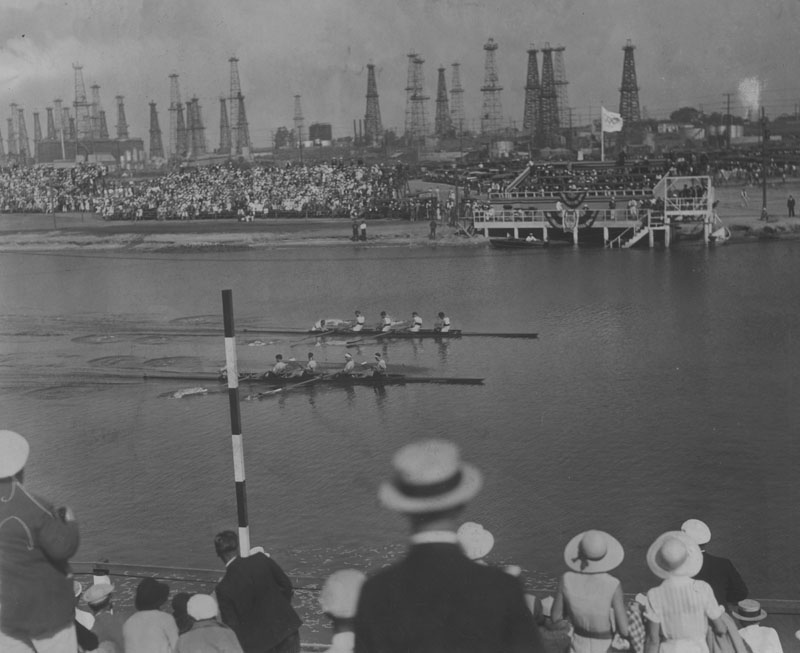
Rowing events were held at Long Beach Marine Stadium. Grandstands, a boat house, and all the other necessary facilities had to be built at Long Beach's expense, so the stadium was turned over to the city at the conclusion and still stands.

Long Beach Rowing Stadium. Photo: LAPL

Remember when I talked about Long Beach and Wilmington oil drilling pre-regulations? Look at that! Oil derricks every few yards. And what a stark contrast to the upper class sport of rowing taking place. Those are four oared boats with a cockswain, the Germans defeating the Italians by one foot. This appears to be the view from one of the 5,000 permanent seats. There were 12,000 temporary seats installed along the course as well as two miles of standing room.

The Riviera Country Club, now known mostly as a championship golf course, held the equestrian dressage events. The Rose Bowl held cycling. Shooting events were held at the LAPD's shooting range at Elysian Park. The Los Angeles Harbor (now Port of Los Angeles) held the sailing events.

The tenth Olympiad was the first to use a podium for the medal presentation. It was also the first time an Olympic Village was built. The male village was built in Baldwin Hills, female athletes stayed in the Chapman Park Hotel on Wilshire.


Friday, July 27, 2012

Los Angeles' Amusement Piers - A History

In Disney's California Adventure, the second gate at the Disneyland Resort, one can walk to the back of the park and experience Paradise Pier. It's themed to be a Victorian turn of the century seaside pier alongside a mythical coast of a California that never was. According to the land's backstory, a man name Gustav Tinkschmidt is the proprietor of the pier which he has built it up with midway games and a gigantic "wooden" roller coaster (it's actually steel painted to look like a turn of the century wooden coaster).

There's a Paradise Garden area with Boardwalk Pizza and Pasta and the Paradise Grill, both according to the backstory started by one Italian family who came over from Italy in the 1930s. They built the smaller Paradise Grill then expanded to Boardwalk Pizza where they could display their flag from the Kingdom of Italy (pre-Itlaian Social Republic).

This is what I love about Disney parks. This effort to tell a story with something like a pizza place, instead of just throwing up a small stucco building to shove food out of.

The look of the boardwalk takes queues from the Hotel del Coronado in San Diego. The 1888 resort hotel with great white walls and brown roofs is a historic landmark, and another example of this turn of the century desire by some east coaster to come out west and build resorts where others of their ilk could come and spend their holiday time.

I've recently gotten into the HBO series Boardwalk Empire, which takes a look at the complicated role Atlantic City played during the prohibition era. The show's creators built a fantastic boardwalk set in Brooklyn to film the scenes taking place on the boardwalk, which has a Ritz hotel, a nightclub, a photography store, and a place where you can see babies in incubators!

So when I talk about the amusement piers of Los Angeles' past, these are the practical turn of the century piers that I've seen to form my opinion of what a turn of the century pier would have been all about.

Ocean Park Pier. Photo credit: LAPL


As you might remember from when I talked about the Seaports and Railroads of early Los Angeles, the first train to Santa Monica arrived in 1889. Abbot Kinney was the first to develop an amusement area in Santa Monica, buying the Ocean Park casino in 1891 and expanding it into a beach resort called Ocean Park. The Ocean Park Pier at the center of the resort was completed in 1898. You can see from the photos, it's much more like the circus-y pier of Boardwalk Empire than the cleaned up version Disney offers.

Going counterclockwise down the photo there's Princess Silver Star - Indian palm reader, something called Barc-a-roll for 10 cents, Souvenir and Gift Shop (a must), the Casino, the Ocean Park Pier Dome Theater with dancing, the Egyptian Ball Room, a popcorn stand, a Coca-Cola ad, the Casino Cafe. I take it back, it's exactly like Boardwalk Empire. No surprise Abbot Kinney was from New Jersey.

Santa Monica's Ocean Park soon had competition brewing down south in Long Beach. We've talked here before how the Spanish Empire's fear of pirate raids led them to build inland instead of right along the ports, which left a lot of beachfront property open for amusement purposes.

Charles I.D. Looff, who built the first carousel at Coney Island, moved out to California in 1910. The Pike at Long Beach had been built in 1902 with arcades and food stands and the like. Looff purchased property on The Pike and built a carousel.

He was then hired by Santa Monica who had decided to build their own municipal pier in competition with Kinney's. In 1916, they built a large hippodrome (greek for horse race stadium) to house a carousel, and a wooden roller coaster known as the Blue Streak Racer. They also built a ride called The Whip (thing of the new Mater's Junkyard Ride in Cars Land).

Blue Streak Racer to the left, Hippodrome to the right. Photo: LAPL

Looff also built amusement piers and carousels at Redondo Beach and Venice Pier as well as the Santa Monica Pier still in operation today. Ocean Park operated until 1957, though it was reopened as the Pacific Ocean Park which was designed to rival Disneyland. Here's a look at Ocean Park's roller coaster, High Boy, as well as a midget car ride.

Big Boy and a Midget Car Ride, Ocean Park. Photo: LAPL

The Long Beach Pike had it's own wooden roller coaster, the most famous being the Cyclone Racer which replaced the Jackrabbit Racer. If you've seen Abbot and Costello in Hollywood, they ride the famous Cyclone Racer in that movie.

While these early thrill rides were surely a lot of fun, they were also a bit unsafe. A trip to Disneyland now shows an extreme emphasis on rider safety, with height regulations and safety belt checks and lap bar checks and mechanical locks that can only be released once the ride is safely stopped. Not so much back in the day. On March 1, 1927, police investigation began after a young man fell 50 feet off the roller coaster into the ocean to his death.

A rider's decent. Photo credit: LAPL

I do love the old newspaper way of diagraming a story. The curlicue is a nice touch. John Lee O'Brien is the name of the 16 year old who feel out of his car. Of course, there are always varying accounts.


Still, these parks were fighters through accidents, Prohibition, the Depression and two World Wars. Anyone who's been to the Santa Monica pier recently can attest that they just don't draw the crowds to keep up with the Disneylands' and Six Flags' of the world. Of course, you can always go to the pier Disney built in the middle of Anaheim, on a mythical coast of the California that never was.


Saturday, July 21, 2012

The Pepsi Generation at Disneyland

Wow, haven't written on the blog for a month. Today I'm going to do something I don't believe I've done here, base an entire entry off a youtube video. Typically, I've focused on the LA history of the time when newspapers and radio were the means of mass communication. Today we're gonna talk about television, advertising, Disneyland (again), and soda pop.

First off, check out this amazing television commercial, shot at Disneyland, for Pepsi Cola.


First, the product. Pepsi was developed in a simpler time, when folk could sell beverages out of their home. It was also a time when carbonated beverages were mixed as pharmacies and sold as elixirs. Caleb Bradham was a pharmacist who graduated from the Univeristy of North Carolina and then attended medical school at the University of Maryland. He left med school to attend to his father's ailing business, and a few years later opened a drug store in New Bern, North Carolina called Bradham Drug Company.

Now, like most drug stores of it's day, this place had a soda fountain, and in 1898 Bradham introduced Brad's Drink which contained soda water, kola nut extract, vanilla and 'rare oils'. There was no pepsin in his drink, but since Bradham believed it aided in digestion (or at least could sell that) he named it Pepsi Cola.

In 1902, the Pepsi-Cola corporation was founded in North Carolina. In 1903, Pepsi registered it's first trademark. In 1905, Pepsi was sold for the first time in six inch bottles. With bottling, we go from Pepsi being a local product to regional and eventually national.

By 1933, after two bankruptcies, Charles Guth had begun to turn Pepsi into a profitable company. The soda was sold by 313 franchised US dealers; bottled in the US, Cuba, and England; and sold in 83 countries.

It had increased its sales by doubling the industry standard bottle (now a 12 ounce bottle) while keeping the price the same. It also began running ads targeting African-Americans, with the slogan "Pepsi-Cola Hits the Spot."

The key point from all this is that Pepsi was big like Coca-Cola, but very much the #2 soft drink. So Pepsi did what politicians and advertisers still do, target specific "fringe"groups. African-Americans, women, and starting in 1960: youth.

Post WWII America, it's been said many times, was an affluent time. With more people going to college, teens with summer jobs, marketing to youth became a key strategy. Not only do you get access to disposable income with few obligations, but it's a long term strategy as those kids become lifetime customers.

In 1960, Pepsi began a long term relationship with a new advertising agency; BBDO. Now, anyone who's watched AMC's Mad Men knows BBDO. They're a real agency, and from 1960 to 2008 they were the advertising agency with the Pepsi account. It's come up a few times on Mad Men, with Sterling Cooper bringing in young copywriters to market coffee to "the Pepsi generation" or the two times SC went after a fringe Pepsi account. There was the attempt to upscale Mountain Dew by making it a cocktail, and making a Bye Bye Birdie based commercial for Patio; the diet drink that became Diet Pepsi.

I put the "Pepsi generation" in quotes, because that was a marketing strategy created by BBDO. They labeled Pepsi as "the choice of a new generation" and advertisements made Pepsi look youthful, joyful, and hip.

Which brings us back to the 1965 Pepsi commercial at the top of the post! Only took nine paragraphs : )

Disneyland had been open for a decade when this commercial aired, opening it's gates on July 17th, 1955 (though officially to the public on July 18th). At this point it was no longer Walt's experiment, and Disneyland was starting to hit its stride with beloved rides such as Pirates of the Caribbean and experiments like the Flying Saucers. If you pay close attention, the commercial wasn't shot all over Disneyland, it was shot in Tomorrowland and Fantasyland.

1964 Disneyland Map

That map really needs to be full-sized to be appreciated in all it's glory. You can see New Orleans Square is still marked as a future attraction. Much of it came to fruition, though Blue Bayou became an upscale restaurant part of the Pirates building and Thieve's Market never came to fruition. It's clearer here (than it may be today) that this is supposed to be New Orleans of yesteryear when it was part American city, part French haven, and part Caribbean pirate port.

Great Moments with Mr. Lincoln had just opened on Main Street, after appearing at the 1964 World's Fair in Flushing Meadows, Queens (future site of Shea Stadium). There were still plans of building a Liberty Street off Main Street, though they never materialized at Disneyland. Neither did Edison Square. This was also the first year United Airlines had sponsored the Tiki Room.

Sponsorship had been from the beginning one of the ways that Disney funded his dream project. It's no surprise that Pepsi shot a commercial at Disneyland considering they were one of those sponsors. Up in Frontierland, you can see Pepsi-Cola presenting Slue Foot Sue's Golden Horseshoe.

The old Horsehoe building was all white, with red white and blue bunting, and banners hanging that read Golden Horseshoe Review with the script Pepsi Cola logo to the left. However, the Horseshoe didn't factor into this Pepsi commercial at all. Let's run down the rides featured. Also, note that the commercial is in black and white. The first big push toward all color television happened in the fall of 1965.

Start with a Skyway car going to Fantasyland through the Matterhorn. Cut to, a happy couple riding the Matterhorn Bobsleds. Brief shot of a sign reading Disneyland (incase you weren't sure where we were).  Cut to, couple riding Dumbo the Elephant. Use Skyway car returning to Tomorrowland to cut to Tomorrowland footage (that's quite clever, this commercial is fantastically scripted). Subway emerging from waterfall. Cut to Monorail. Getting off the train, getting a Pepsi from a vending machine at the station. And finish with happy girl on Flying Saucers.

Disneyland Skyway. Photo credit LAPL


Fantasyland has changed quite a bit from 1965 to the present day. The Dumbo ride was over by the entrance to Frontierland and the Skyway station (no longer in use), which makes the narrative of the commercial make sense. The part where the Skyway passed through the Matterhorn was called the Skyway through Glacier Grotto. The reality was less a a glacier grotto and more looking at the Matterhorn cars climbing their first hill.

Original Dumbo Ride. Photo credit LAPL


After taking a Skyway car back through the Matterhorn, our happy couple goes on the Submarine Voyage, which would have still been painted military grey and not the explorer yellow subs of today. The couple rides the monorail (which by that point had a second stop at the Disneyland Hotel) before hopping on the Disneyland Railroad (which stopped at Fantasyland [soon New Orleans Square] Fantasyland [soon Videopolis then Toontown] and Tomorrowland.

Now we're gonna spend some time with the product. We see the (then) new Pepsi logo, of a red and blue Pepsi Cap with Pepsi in block letters. The glass bottle rolls out of the vending machine, and there's a built in bottle opener. While throughout the commercial we've just heard the refrain "Come alive, you're in the Pepsi generation", now we get the full ad copy touting all the benefits of drinking Pepsi.

It all sounds so youthful. More spark, more swing, it's crisp and bold. We also get an extended look at the couple. They're both wearing sweaters, and collared shirts, but she's got her hair pulled back with a fabric headband. His hair is neat, but long; she's wearing a skirt but it's knee length and sporty. This is the young face of a generation.

The Flying Saucers we close on only lasted for five years. Using the same technology that has inspired Luigi's Flying Tires at California Adventure, this E ticket attraction was a space age take on bumper cars. The space is where the Magic Eye Theater sits now (currently showing Captain Eo, in front of where Space Mountain would be built.


The Douglas Aircraft Company Rocket to the Moon became the trip to Mars and is now a pizza place. Not yet built is the Carousel of Progress, which stayed at the New York World's Fair through 1964-65 and was brought to Disneyland in 1967; displacing the Space Bar and dancing area. 

1967 was the year New Tomorrowland debuted. Those hip kids looking for a place to dance would get the Tomorrowland Terrace sponsored by none other than Coca-Cola. Pepsi's youth oriented advertising culture had caught on if Coke was sponsoring dance plazas. As part of the New Tomorrowland remodel the Astro Jets in the center of Tomorrowland were raised and renamed the Rocket-Jets; placed above the new PeopleMover.

Disneyland kept changing as the world kept changing, which suited the Pepsi Generation just fine. It was the coffee drinking Mad Men who'd have to adjust.