Thursday, May 24, 2012

The Los Angeles Kings - A History

With the Los Angeles Kings in the Stanley Cup finals for the second time in their history, I thought it time to look back at one of the NHL's first expansion franchises. I've talked here before about the Los Angeles Monarchs, who played at the Pan Pacific Auditorium and inspired the naming of LA's NHL franchise. The Monarchs are still the only Los Angeles hockey franchise to win a title, the President's Cup of the Pacific Coast Hockey League.

The Monarchs folded in 1950, along with the PCHL's Southern Division, but with the opening of the Los Angeles Sports Arena in 1959 LA was able to enter the Western Hockey League as the Los Angeles Blades in 1961. The Blades shared the Sports Arena with the Lakers.

Much like MLB coming west in 1959 thwarting the PCL's bid to become a major league, the NHL began to feel threatened by the WHL in the 60s. It was time for these so called National Leagues to expand to the West coast as the NFL had way back in 1946.

The NFL, MLB, and NBA all initially expanded when east coast owners sought breathing room on the west coast and moved out. However, the NHL was just a six team league at the time with firmly entrenched fan bases, so it would have to expand its footprint with expansion franchises.

The Los Angeles Kings were one of six expansion franchises announced in 1967, the others being the California Seals (a nod to Bay Area PCL franchise San Francisco Seals), Minnesota North Stars, Philadelphia Flyers, Pittsburgh Penguins, and St. Louis Blues.

The two West Coast teams were an aim not only to stop the WHL's influence, but the NHL had lost its TV contract with CBS so placing a team near Television City in Los Angles wasn't a bad idea. Coincidentally, CBS Television City is built on the former Pan Pacific Auditorium site where the Monarchs skated for a decade.

Washington Redskins owner Jack Kent Cooke had bought the Lakers in 1965 from Bob Short, who bought the Lakers in the 40s and moved them out of Minnesota where hockey was more popular. He paid $5 million for the Lakers, who were one of the NBA's most popular teams due to their rivalry with the Celtics.

Cooke paid $2 million to the NHL for the expansion franchise, which he named the Kings. Cooke wanted the Kings to play in the Sports Arena with the Lakers, but the Coliseum commission who run the Sports Arena already had an agreement with the WHL LA Blades. So to house both his franchises he built The Fabulous Forum in Inglewood, and dressed both teams in the purple and gold of royalty (the Laker name was too valuable to change).

Los Angeles King's second ever game, against expansion Minnesota North Stars at Long Beach Arena. Photo credit Los Angeles Public Library. 

However, the Forum wasn't ready in time for the 1967 NHL season. The Kings began their existence at the Long Beach Arena which was built in 1962 as part of a convention center. Interestingly, that was the second arena built on the site, as Long Beach built the Long Beach Municipal Auditorium and Rainbow Pier in 1932


Sorry for getting sidetracked, that's just a really awesome looking auditorium. It appears it was used mostly for concerts and the like, where as the Long Beach Arena was intended to be a sports and concert venue. 

So the Kings played their first game at Long Beach Arena against the expansion Pittsburgh Penguins, which they won 4-2. The photo above is of their second game, also against an expansion team. The LB Arena is much more intimate, and you can see in the photo that the NHL at the time was in the practice of dark jerseys at home (this would switch, and then back again in the future). The Kings wore all purple at home that first year, with a gold and white crown logo. 

The Kings also played some home games at the Sports Arena, and two months into the season the Forum was completed. The Kings finished second in the West, which was made up entirely of expansion teams. However they barely qualified for the playoffs the following year, then did not qualify for four straight years. 

By the time the Kings made the playoffs again, the NHL had added four more clubs to combat yet another competitor the World Hockey Association. This East coast and Canada based league necessitated the Vancouver Canucks, New York Islanders and Buffalo Sabres, as well as the Atlanta Flames. The league chose to put Vancouver in the East (so they could play Canadian teams), and Atlanta in the west taking the Chicago Blackhawks (one of the original six) with them to build rivalry with the nearby Minnesota North Stars (which wouldn't keep Minnesota from eventually moving). 

All this meant that by the time the Kings could make the playoffs again, they were quickly eliminated by experienced Chicago. The NHL restructured again in 1974, which put the Kings in a division with the Canadiens, and Red Wings.

The Kings wouldn't catch a break until they traded for Wayne Gretzky in 1988. Gretzky had won four Stanley Cups with the Edmonton Oilers, so the Canadian's arrival in Los Angeles was a huge deal and upset a lot of Canadians.

Gretzky would lead the Kings to their only Stanley Cup appearance before this one in 2012. The team changed their purple and gold color scheme, which had become solely associated with the great Laker teams of the 80s, and adopted the black and silver scheme of the Los Angeles Raiders.

The Kings brought back the purple after moving into the Staples Center built by new owners AEG. However, they brought back the black and white this season, and goalkeeper Jonathan Quick has been hot throughout the playoffs. So good luck and go Kings!

Tuesday, May 1, 2012

Wrigley Field Hosts US vs. England Soccer

The year was 1959. The Dodgers had just moved to Los Angeles from Brooklyn, which meant the Los Angeles Angels left town for Arizona. This left Wrigley Field in South Los Angeles unoccupied. In May of 1959, with the first LA Dodger season taking place up the road at the Los Angeles Memorial Coliseum, the US National soccer team took on the English soccer team in a friendly match at Wrigley Field, which really must have been a hoot.


I just learned of this event, thanks to the LA Times LA History blog. For a bit of context, in 1950 the US had upset England at the World Cup in Brazil 1-0. Back then it was just two points for a victory, as it still is in hockey, and that was the US' only victory in the tournament so they didn't make it out of their group. Only the top team from each of four groups was taken, with a final group round instead of a knockout stage to decide the winner. England didn't make it out of the group either.

Europe hosted the next two World Cups, and then the 1962 World Cup was set to be hosted by Chile. This meant England needed some experience abroad again, which facilitated the 1959 tour. The English started in Brazil (lost 2-0) then to Peru (lost 4-1) and on to Mexico (lost 2-1).

It was the start (or at least the first instance I've seen) of Los Angeles being the defacto soccer capital of the United States. At the very least, it was the first time a European national team had come to Los Angeles. Before then, New York was the destination port for European clubs for obvious reasons.

The English practiced at Hollywood High School, and was headquartered at the Hollywood Roosevelt. As for Wrigley Field, which had been deemed too small for Major League Baseball, was transformed into a soccer pitch; hastily. The dirt of the baseball paths was still down, and sat in front of one of the goals making things difficult for everyone.

There's an excellent writeup of the match here. About 10,000 fans in attendance which would be about half full at Wrigley Field. The US, wearing navy blue kits, scored first, but then England came back with a staggering eight goals.    


Just look at glorious Wrigley Field. To be fair, any ballpark can look glorious in the sun. It is quite compact, I imagine the soccer pitch must have been quite a tight fit. When Wrigley Field in Chicago has done soccer matches, the length of the pitch is along the first base line, mostly in the outfield. The base path does overlap onto one of the corners almost touching the goal, so that seems to give with the description in the blog. 

Monday, April 2, 2012

West Hollywood

Not one to let a good meme die, I figured I'd take a look at the history of other LA neighborhoods, and the landmarks they contributed to this 1937 Hollywood Star Map. Having already tackled the Los Feliz/Silverlake/Griffith Park area, we'll move on down the road to West Hollywood. In my Carthay Circle Theater/Red Car article, I mentioned that Sunset Junction took it's name from a Red Car stop and that West Hollywood actually began as a railroad town. This KCET article has the scoop, but I'll pull out the relevant details.

One of Southern California's first electric interurban railroads was the Pasadena and Pacific, stretching from LA to Santa Monica in the Cahuenga Valley; it is now Santa Monica blvd. The railway was constructed in part by Moses H. Sherman. Because rail cars need servicing, Sherman built a small yard midway on the line and the yard workers bought lots around the yard to build houses on. The town was named after its founder Sherman.

Sherman was just outside the boarders of Hollywood, which was an independent city from 1903-1910 before it was annexed by the city of LA. Sherman, as well other Hollywood adjacent town Colegrove housed some of the spillover from Hollywood; sets and studios and nightclubs.

Of course, one can attract Hollywood types better with a name like West Hollywood than Sherman so in 1925 the city voted to officially change it's name. I love this bit:

The August 23, 1925 Los Angeles Times reported on the controversy: "Like a healthy, outdoor child, Sherman has suddenly burst all her old dresses and thinks while she is getting a wardrobe, suitable for a fully grown girl, she might as well discard plain 'Mary' and become up-to-date 'Marie.'"
Looking at the Stars map from 1937, we can see that many of West Hollywood's landmarks were nightclub related. For instance, there was the 1934 night club Cafe Trocadero.

Cafe Trocadero, 1930s. Photo LAPL

It might not look like much, but that Sunset Strip hotspot was the place to be if you wanted to jitterbug. The club was founded by William Wilkerson, who was famous for founding The Hollywood Reporter. He also owned nearby clubs Ciro and LaRue, which were not cool enough to make it onto the Stars map. Because it was frequented by Fred Astaire, Cary Grant and the like it was popular for Hollywood movie premier parties. 

Cock and Bull, 1940s

If you were looking for a Halloween party, or just for a good British pub, you might want to check out the Cock and Bull. Here the lovely Diane Smith bobs for apples as her apples bob (hi-o!) in a fairy tame Halloween environment. The Cock and Bull was founded not by an Englishman but an Anglophile named Jack Morgan. It was a more informal place than the other Sunset Strip night houses, where autograph hounds and paparazzi weren't allowed inside. It closed down in 1987, long after the Trocadero was a parking lot. 


It wasn't just nightclubs that you'd find in West Hollywood. It was also a place for some high end restaurants. Bit of Sweden is just one such place, but when it was marked on the map with a viking I just couldn't rest. Love that not only is it serving up Swedish favorites, but doing it smorgasbord style.

Back down on Santa Monica Blvd. the Pacific Electric railway continued to run cars until 1941. Not an incorporated city, not annexed by LA, and with it's Hollywood nightlife declining - West Hollywood was ripe for a demographic change. By 1984, the town had become a haven for gays and lesbians in Los Angeles. Almost twenty years after a police raid at the Black Cat club in Sunset Junction, and four years after the first Sunset Junction Street Fair, West Hollywood voted for incorporation and a majority of openly gay city council members. 

What I love about West Hollywood (beyond the obvious) is that it shows the fluid nature of communities. From rail yard to movie star hot spot to immigrant neighborhood to openly gay community. 

Anyhow, since we've done East Hollywood and West Hollywood, I guess we can do South Hollywood (Colgrove Addition) next. See y'all soon

Sunday, April 1, 2012

Los Feliz, Silver Lake, and Griffith Park

It's become clear to me as I've continued to write in this blog, that despite my initial fascination with the organization D LA (it's roads and trains and phone connections), I am truly a child of this company town. The history of theater and motion pictures and television broadcasts, back when cities were concentrated entities this defined Los Angeles. It still is a company town, but Broadway, Hollywood Blvd, the movie palaces have all been allowed to decay. Which to me is a bit sad.

As a result, I love it when I get pulled to look at another aspect of Los Angeles. Disneyland inspired me to write about Carthay Circle, and it's my other happy place that's inspiring today's entry; The LA Zoo.

Since I've written much about Hollywood and Downtown, I want to make sure I start from the beginning when talking about Griffith Park - since it really is an important part of Los Angeles history. I'll be referring (in my head) frequently to this star map from 1937, and going through the landmarks east of Hollywood. KCET linked to this map as context for a showing of A Star is Born (1937)

While most people know feliz from the phrase Feliz Navidad, in this case Los Feliz actually refers to Rancho Los Feliz; a 6,647 (27 square kilometers) acre land grant given to Corporal Jose Vicente Feliz by the Spanish government. His adobe house, built in 1830, still stands in Griffith Park on Crystal Springs drive.

That ranch got broken down into many parts. There is the 7 km-squared neighborhood of Los Feliz. Down the road is the 7 km-squared neighborhood of Silver Lake. Silver Lake is named for one of two concrete reservoirs in the neighborhood. That reservoir in turn is named for water board commissioner Herman Silver. The Silver Lake reservoir provides water for 600,000 Los Angeles households.

Walt Disney Studios on Hyperion, photo LAPL

East of the very large Silver Lake reservoir and the smaller Ivanhoe reservoir sat Walt Disney's original studio on Hyperion Avenue in the Silver Lake neighborhood. This photo is from 1936, one year before the release of Snow White. Disney had purchased the studio in 1925, and it's here in 1928 that Disney created Mickey Mouse and stared producing a series of Silly Symphonies type shorts. Snow White was also animated here, and the revenue from that movie was used to purchase the Burbank studio. Of course, if you read my last article, Hyperion Theater was the name given to the centerpiece of California Adventure's Hollywood area. 

Further north, at the corner of Los Feliz blvd and Riverside Dr. sat Victor McLaglen Field. McLaglen was a film star in the 1920s and 30s, and the field hosted equestrian events like polo and rodeos. 

North of both neighborhoods lies the immense Griffith Park. Colonel Griffith James Griffith (must be good to be a Colonel) acquired 16.5 square kilometers of Los Feliz in 1882. Griffith donated 12.2 square kilometers of that land to the city as Griffith Park.

Now in 1910, the City of LA annexed 7112 acres of land (the Los Feliz grant was 6,647 acres) as the East Hollywood edition (Hollywood was annexed weeks earlier). This chunk of land contained the whole rancho, which included a stretch of the LA river, the reservoirs, and Griffith Park. 

Greek Theater, Los Feliz 1937. Photo LAPL

Here's one of the centerpieces of Griffith Park, the Greek Theater. A 5,700 seat amphitheater built in 1929, and paid for by Colonel Griffith. Like the park, it belongs to the City of Los Angeles. The stage is modeled after a Greek temple, and designed for great outdoor acoustics. It's been used for concerts, plays, and graduations over the years. I saw Silversun Pickups here for the first time, a really great concert. 

Griffith Observatory, photo LAPL

Griffith also lends his name to the observatory, atop one of the park's many hills. Opened to the public in 1935, the observatory contains not only the great telescope, but an exhibit hall and a planetarium. It's one of the great LA landmarks, made popular around the country in James Dean's Rebel Without a Cause. There is a memorial to the deceased star at the observatory. 

LA Zookeeper, 1910


Not featured on the map but also in Griffith Park is the little bit that started this entry, the LA Zoo. The original zoo also bore Griffith's name. It opened in 1912 as the Griffith Park Zoo, about two miles south of the Zoo's current location. As you can see in the photo, zookeepers looked a bit different 100 years ago. The LA Zoo has long been a red headed stepchild compared to the leading So Cal Zoo in San Diego, although it has stepped up offerings in recent years. It's a favorite of media darling Betty White, and many other Hollywood philanthropists. 

So there you have it, one of the first ranchos in Los Angeles remains a natural preserve just north of downtown and east of Hollywood. Easy to ignore, it's an important cultural spot in Los Angeles, and one of my favorite places. And to think, most of it was built by WWII. 


Thursday, March 29, 2012

Carthay Circle Theater

One piece of history I've been dying to write about, but haven't yet because so many others seemed to already be on the case, is the Carthay Circle Theater. Right now it's a buzz worthy historical item because Disney's California Adventure is building a replica as part of their remodel set to open June 15th. It's been written about by Disney Parks, and KCET so what could little old me really add? Well, I'm gonna do it anyhow.

To give you a greater historical scope, Disney's California Adventure already has a Hollywood Blvd (with Hollywood Golden Age era facades) that meets up with Sunset Blvd (where the Tower of Terror sits), and a centerpiece theater called the Hyperion, with a facade meant to invoke the old Los Angeles Theater on Broadway.

What they're adding is the Carthay Circle Theater with a small plaza in front, and a stretch of road that will be known as Buena Vista St. That street will also have 1920s inspired storefronts. To connect it all, California Adventure is bringing back the Red Car, just like San Pedro did on it's waterfront.

Fox Carthay Circle on the night of a premier, photo credit LAPL

The Fox Carthay Circle held many premiers in it's day, with bleachers set up so fans could see the various stars arrive. My grandmother has told me stories about being taken to the Carthay Circle by her older relations to see such an event. The Carthay Circle sat on San Vicente between Wilshire and Olympic (not too far from LACMA, West Los Angeles) until it was demolished in 1969 to build an office park. 

Carthay Circle 2012, Disney's California Adventure, photo credit Josie Becker

Luckily for this amateur historian, the theater is reborn in 2012, standing tall in California Adventure. So just what is the theater's significance to Disney? Well in 1937 it hosted the premier of Snow White, Disney's first feature length film. 

Snow White original run poster

If you look at the Disney Parks article linked above, they have another really neat poster, a photo of the crowd awaiting the premier at Carthay Circle Theater, the playbill, just all sorts of neat stuff. It was a record setting event. The theater had 1,518 seats that sold out for $5 a pop (that's $79.05 in today's money) at a record pace, and 30k gathered outside just to see what was going on. 

The film grossed $8.5 million ($134,384,409.72 in today's money) at a cost of $1.4 million (a nice profit) giving Disney the power to make classics such as Pinocchio, Dumbo, and Bambi in the 40s. The enthusiasm about the film, as well as requests for some sort of studio tour, led Disney to begin planning what would eventually become Disneyland. 

An early Disney attempt at giving fans an attraction where they could live the films. 

Of course, it wouldn't be the Disneyland way to simply stick Carthay Circle in the middle of a modern world. Buena Vista St. and the return of the Red Car will do much to try and transport visitors back to the world of the 1930s (minus the war in Europe and terrible affects of the Great Depression of course). Disney Parks Blog wrote about the return of the Red Car yesterday (link). 

The Pacific Electric Red Cars in the wild, headed to Santa Monica.

Before the abundance of freeways, these trolleys were the dominant mode of transportation in Los Angeles. Santa Monica Blvd. had a median in the middle for two sets of tracks (as seen here and in the KCET article). The trains picture in that photo were part of the West Hollywood line, KCET has written about how West Hollywood grew out of a rail yard town named Sherman. Sunset Junction, another key figure in the Gay Rights struggle, also takes it's name from the Red Car system (also via KCET)

So if you go to California Adventure this summer to check out the new Cars Land be sure to give some love to the time that launched the Disney corporation. I know it's what I'm excited about. And as a bonus, here are the costumes that will be worn by Cast Members assigned to this area; as shown at an Annual Passport holder preview. This could also be labeled, Disney goes into my closet. 


Sunday, February 19, 2012

Los Angeles Angeles of Anaheim, California

As I've tried to illustrate on this blog before, baseball didn't begin in Los Angeles with the Dodgers and Angels. There was 50 years of baseball history in LA before the Dodgers arrived, from the Cubs holding Spring Training on Catalina Island, to the Wrigley family investing in the Los Angeles Angels. The Angels played (and thrived) at Wrigley Field in South Central LA. They had competition from the cross town Hollywood Stars who played in West LA.

I've yet to venture into Orange County on this blog, so my first venture across county lines is going to be about baseball and a whole lot more. It's probably not surprising that Orange County was once a part of Los Angeles County, divided off in 1889. The 213 area code used to stretch all the way to the Mexican border, until a flash cut in 1951 created the 714 for Orange and San Diego Counties.

Philadelphia Athletics in Anaheim for Spring Training

Los Angeles had Wrigley Field (1925) and Gilmore Field (1939), and not only did these facilites house Pacific Coast League teams, but they hosted Spring Training for major league teams. The Chicago Cubs and New York Giants both spent Spring Training time in Los Angeles, with the Cubs building a permanent facility on Catalina. 

At the same time Gilmore Field was opening, Anaheim opened it's first baseball stadium: La Palma Park Stadium. At the intersection of Harbor and La Palma ave, the stadium was built to house Anaheim's entry in the newly founded California League. 

There had been several attempts to start a California league since the turn of the century. The California State League of 1899-1902 was affected by the National Agreement between the National and American Leagues. Six franchises, including the LA Angels, broke off to form the Pacific Coast League which fell under the National Agreement.

In 1941, the current California League was formed with franchises in Anaheim, Riverside, Bakersfield, and Santa Barbara to name a few. The Anaheim team was known as the Anaheim Aces and played at La Palma Park. It's a small park (it still stands), which held just 3504 spectators when it opened. 

The Aces only lasted one year, but they weren't the only team to use the park. The Philadelphia Athletics held Spring Training there from 1940-42. You can see in the photo, they were a hit with the local ladies. 

World War II forced the Athletics to not come back. Anaheim would try minor league baseball again in 1947 with the Anaheim Valencias, founding members of the short lived Class C Sunset League. 

Anaheim Valencias, 1947

The Valencias were actually successful, winning the Sunset League title in 1947. Their uniforms are obviously inspired by the Philadelphia Athletics who had held Spring Training there, and the oranges on the shoulder should be a clue that they were named after the Valencia oranges grown locally. In fact, the California Valencia Orange Show (a bit of a trade show for orange growers) was held at the site of La Palma Park Stadium in 1931.

That's a lot of oranges! (Photo courtesy Orange County Historical Society)

The Valencia's battled the Riverside Dons and the Ontario Orioles for two years, before television broadcasts of Major League games hurt attendance at minor league ballparks nationwide. The Valencias folded after the 1948 season. 

Professional organized baseball wouldn't return to Anaheim until 1965, but Anaheim would change forever in 1955. Walt Disney had been drawing Mickey Mouse shorts since 1928's Plane Crazy. In 1937 his first feature length cartoon Snow White premiered at the Carthay Circle Theater. 

Disney didn't invent the idea of the large fair, New York and San Francisco held large expositions, nor did he invent the large park (Griffith Park and Central Park were certainly inspirations. What Disney did was have the wherewithal to combine the two concepts with giving fans of his films something to visit (studio tours of an animation studio lacking a bit of pizzaz) creating Disneyland which opened in 1955. 

Disney bought 160 acres of orange groves and walnut trees in Anaheim, and spent $17 million on construction which took one year. The Santa Ana Freeway (then US 101, now I-5) was completed in 1956, linking Los Angeles with Disneyland directly. In fact, on this map (1958) the adress is listed as Santa Ana Freeway at Harbor Blvd. a sign of the changing (more suburban) nature of Los Angeles and Orange counties where address were relative to nearby freeways, instead of local cross streets.


That image and the upcoming images that inspired this triple entry (Orange County, Disneyland, and baseball) all come from Vintage Disneyland Tickets, a website I consider a must see for any LA history enthusiast. 

Dodger Stadium broke ground in 1959 on 352 acres costing $23 million to build (privately financed). It was built off the Pasadena Freeway, just south of the junction with the Santa Ana Freeway. It opened in 1962 and while it was built by the Dodger owner Walter O'Malley for the Dodgers, it would open with two tenants. 

The Dodgers moved to Los Angeles in 1958 after O'Malley purchased and moved the Los Angeles Angels. As the Brooklyn Dodgers, O'Malley sought a replacement for the aging Ebbets Field in Brooklyn. He wanted another site within the borough, but New York City official Robert Moses wanted to build the stadium in Queens on the site of a former World's Fair. 

Moses was a big proponent of freeways, and with his public funds was responsible for the Triborough Bridge and was just generally always in favor of car culture over public transportation. O'Malley wanted nothing to do with Queens, and came out west for a new beginning. Moses would eventually build his stadium, Shea Stadium, which became the home of the New York Mets in 1964. 

The New York Mets were an expansion franchise granted to the National League to replace the Dodgers and Giants who both left New York in 1958. They entered the league in 1962, paired with the Houston Colt 45s. The year before the American League had expanded, placing franchises in Washington and Los Angeles. 

The Washington franchise was a replacement for the Senators who had left for Minnesota. The LA franchise was the American League keeping pace with the westward heading National League. 

The Dodgers adopted the cap logo of the original LA Angeles, but the American League LA franchise owner Gene Autry paid the Dodgers to use the name. Since the original Angels had been moved elsewhere, the AL LA Angels moved into vacant Wrigley Field for the 1961 Season. 

While the Dodgers were playing in a cavernous football stadium (the LA Coliseum), the Angels were playing in the majors' smallest ballpark. It was only 340 to left field, and the Angels pilled up an then franchise record 240 home runs. 

When Dodger Stadium opened up in 1962, the LA Angels moved in though they called it Chavez Ravine. Gene Autry sought a stadium site in Los Angeles, even Long Beach. The City of Long Beach wanted them to be known as the Long Beach Angels, so that was nixed. The team ended up striking a deal with the City of Anaheim. 

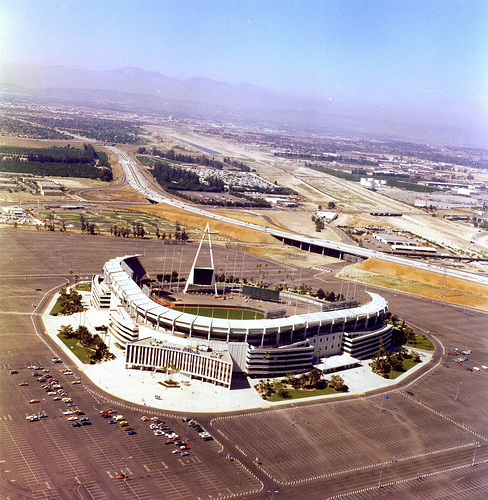
Anaheim Stadium 1977. The Orange Freeway in the background was finished in 1975.

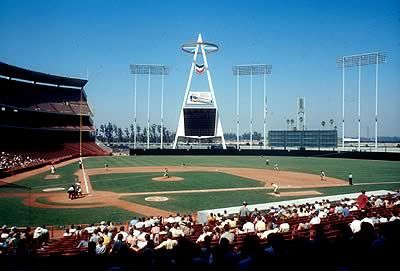
In contrast with Dodger Stadium, it was the City of Anaheim that financed Anaheim Stadium. It was built on 160 acres (same size as Disneyland) at $24 million. Like Disneyland it was built off the Santa Ana Freeway (Orange Freeway wasn't completed yet. Note the original home plate gate before Disney renovated it, and the Big A in the outfield holding up the scoreboard instead of a marquee by the freeway. It opened in 1966, at which point the team became the California Angels, with an interlocking C-A instead of L-A in the original logo.


With all of that as background we get to the item which inspired today's post. In 1967, the California Angels' second year in Anaheim Stadium, a deal was offered where one could purchase tickets for a doubleheader. For the low price of $5.00 each, fans would get a ticket in the reserve level at Anaheim Stadium to watch the Angels take on the Cleveland Indians at 3:00pm on Saturday. They would then have access from 8pm to 1am to a special party at Disneyland Park. 


The 3:00 start is interesting. In England, soccer matches traditionally started at 3:00 because that was just after the factories closed on Saturdays. At Disneyland patrons would have access to all attractions without the need for individual tickets. It really was quite the deal. And it represents the symbiotic marketing of the Angels and Disneyland which still happens today. 

On the back is a complete Angels schedule. Night games (8:00 starts) are designated with light bulbs. You can see that day games usually start a 1:00pm, so the doubleheader start time was a special deal. There was also a twinight start with first pitch at 6:00. Now most every MLB game starts at 7:00pm. 

Anaheim Stadium from the inside, 1966. 


There are also a number of scheduled doubleheaders. And look at that, Anaheim Stadium was granted the All Star Game in just it's second year of existence. The LA Coliseum would host the All-Star Game one year after the Dodgers moved to LA, but Dodger Stadium wouldn't host an All-Star game until 1980 (and hasn't since). Part of that is just a result of baseball's rapid expansion in this time period, meaning plenty of new stadiums to work into the rotation (and revisiting some classics) not to mention the rise of the NFL leading to multipurpose stadiums being built in many cities. 

So there you have it, a brief history of baseball in Anaheim and Disneyland Park, and how it all came together in 1967. 

*Updated to correct dates, and to add photos of Anaheim Stadium. 

Wednesday, February 8, 2012

Broadway Theater and Commercial District

After reading about the restoration of Clifton's Cafeteria on broadway, and learning that it's part of a greater Broadway restoration project, I was intrigued enough to dive into a topic that I've flirted with a few times before. This restoration project defines the Broadway Theater district as Broadway between 2nd and Olympic. This includes 12 different movie palaces. 

Outside of Clifton's Cafeteria, celebration of the end of the second great war. Photo credit: LAPL


Olympic blvd was formerly 10th st. downtown, so that's an 8 block stretch with 12 theaters. Fun fact, it was renamed after the 1932 Olympics, the 10th rendition of the games.

I've written in the past about Lowe's State Theater (Broadway and 7th) but the Warner, Paramount, and RKO faced Hill St and aren't part of the redevelopment. I also used a photo I took of the Million Dollar Theater (Broadway and 3rd) used in (500) Days of Summer. That leaves ten other theaters I didn't know about : )

Broadway was originally Fort St., part of the original 1849 grid, and was renamed in 1890. The first theaters to crop up on Broadway were vaudeville houses in the early 1900s. The Orpheum and Pantages were part of their owner's respective theater chains. Pantages opened a theater in 1910 (now the Arcade Theater at 5th and Broadway), and then the original Orpheum opened up in 1911 (now the Palace Theater at 6th and Broadway).  

Vaudeville wasn't the only game in town, the Cameo would open in 1910 as a nickelodeon seating 775 people. Seven years later the Rialto Theater would open, giving Broadway two vaudeville theaters and two nickelodeons. There was also a traditional theater house in the Globe Theater (originally the Morosco) opened in 1913.

Million Dollar Theater with original marquee and facade. Photo credit: LAPL


By the end of the decade two movie palaces had opened up, the Million Dollar Theater in 1918 and the United Artists in 1919. The Million Dollar Theater was Sid Grauman's first project and the northernmost of the Broadway Theaters.

As the movie industry took of in the 1920s, Lowe's opened the State Theater in 1921 which could handle both movies and live vaudeville. In 1927 the Tower Theater opened. It was the first theater designed by S. Charles Lee, and the first theater in Los Angeles equipped for talkies.

Los Angeles Theater with City Lights on the marquee. Photo credit: LAPL


Lee also designed the Los Angeles Theater which opened in 1931. One of the grandest movie palaces ever built, it opened with Charlie Chaplin's City Lights. It featured an electric monitor of available seats,  neon floor lights, a restaurant, playroom, soundproof cry rooms, smoking room with built in cigarette lighters, and a lounge that featured a second screen which showed the film via a series of mirrors and prisms. The toilet stalls were marble!

The Roxie was the final theater to open in 1932. However, theaters weren't the only thing that cropped up on Broadway. As anyone who's been to a mall knows, a theater draws a crowd and where there are crowds department stores will open.

The first born of these department stores took it's name from the street, The Broadway. The Broadway would grow into one of Southern California's dominant department store chains, before most of them were sold off and became Macy's. Bullocks, May Company, and the 5th St. Store also sprung up along Broadway.

The entire Broadway Commercial and Theater district has been declared a National Historic Place, as well as the Bradbury Building and Million Dollar Theater.

Like many of the great things of the Roaring 20s, it was the Great Depression that stopped development on Broadway. After World War II as the freeways sent Angelenos out to the suburbs and suburban malls and theaters opened up, the Broadway district began to decay.

The restoration of Clifton's Cafeteria, which opened in 1916, is a positive sign that the revitalization initiative is making progress. Known for their charitable donations and "pay what you can" policy, keeping this type of place which has meant so much for so many generations alive is key in any community. So huzzah to the Broadway revitalization project. Huzzah.